Fiction and education, not advice. See our Disclaimer.
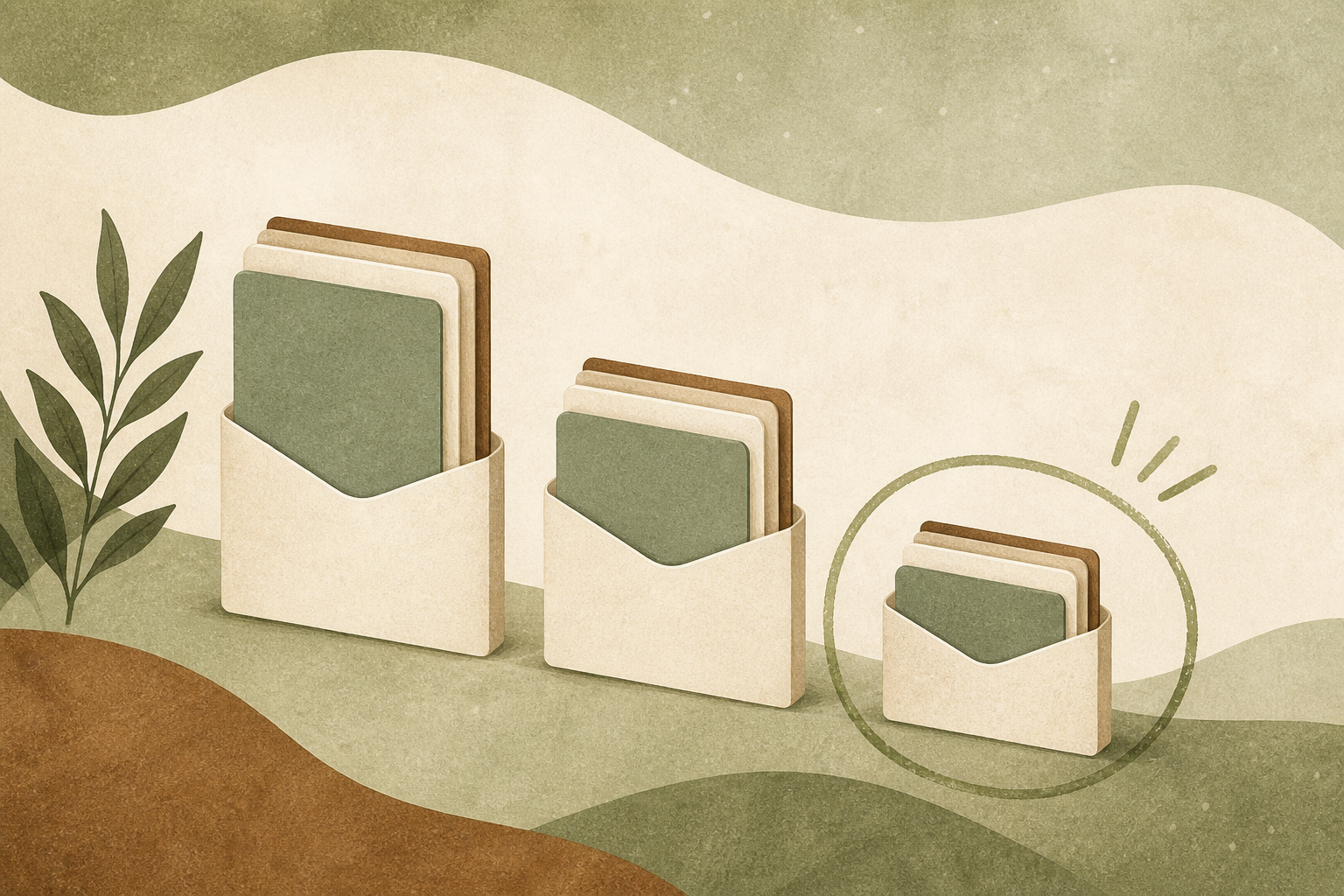
The debt snowball is a payoff order. You list the balances. You keep paying the required minimum on each one. Any extra dollars you can send this month go to the smallest balance first. When that one hits zero, those extra dollars plus its old minimum roll onto the next-smallest. The pile of extra payment gets bigger. That is the snowball.
That is a classroom description of a method. It is not a plan for you, and it is not a promise that debt gets cheaper or faster.
A made-up example, so the arithmetic is visible
Imagine three cards, none of them real:
- Card A: $800 balance, $25 minimum
- Card B: $2,400 balance, $60 minimum
- Card C: $6,100 balance, $140 minimum
Under a snowball order, Card A is first because $800 is the smallest number on the list, not because its APR is the highest or the lowest. If this fictional person can put $200 extra toward debt this month, that $200 lands on A on top of the $25. When A is gone, the next month’s “extra” is $200 plus the $25 that used to go to A, and that whole amount points at B.
The interest rates never appeared in that paragraph. That is the point of the method, and also its main criticism.
What the snowball is optimizing
Behavior. A closed account is a finished sentence. Some people find that easier to keep doing than a spreadsheet that says “this $40 extra should have gone to the 22% card.” The snowball is a motivation story dressed as math.
Motivation is not magic. A closed $800 card does not change the APR on the $6,100 card. Interest keeps charging while you are celebrating the small one. If the biggest balance also has the biggest rate, the snowball can cost more in interest than another order. That is not a rumor. It is arithmetic.
The other classroom method, so this is not a pitch
The common counterpart is the debt avalanche: same minimums, extra dollars to the highest interest rate first, regardless of balance size. The classroom claim is that avalanche usually pays less interest if someone actually sticks with it. The classroom claim for the snowball is that more people stick with it because a balance disappears sooner.
Which claim wins for a real person is not something a blog can know. Sticking with a plan, missing a payment, a new emergency, a 22% card vs a 6% loan, a collections account, or a paycheck that disappears next Thursday all change the comparison. We will not pick a winner from here.
What a snowball does not do
- It does not lower your rate. A hardship program, a refinance, or a settlement is a different conversation with different risks.
- It does not replace an emergency buffer. Knocking out Card A and then putting a car repair back on Card C is a loop, not a method.
- It does not tell you whether to pause investing, skip a 401(k) match, or keep a minimum in a workplace plan. Those are tradeoffs for a licensed professional and a real tax return.
- It does not work the same on every kind of debt. A federal student loan, a car loan with the title on the line, a medical bill, and a store card are not interchangeable plot devices.
How this shows up in the cast
Derek Hall is the obvious story beat: retail hours, a 22% card, and a monthly report that has to look at payoff order without pretending there is one correct answer. Jamie, the thin-cash founder, is the other side: extra dollars toward a card only exist in months the business does not eat first.
If we walk Derek through a snowball one month, treat it as fiction that makes the steps visible. See the Disclosures. Results are not typical because the results are not real.
A plain way to read the method (still not advice)
If you are only trying to understand the vocabulary, the snowball answers four questions:
- What are the current balances, not the original ones?
- What is the required minimum on each?
- Which balance is smallest, and what extra amount (if any) is actually available this month after food, rent, and the lights?
- When one hits zero, what number rolls to the next?
A licensed advisor, credit counselor, CPA, or attorney can apply that to a real list of accounts. We cannot. We write made-up people on purpose.
Education and entertainment only. Not financial, tax, or legal advice. Paying debt has tradeoffs. You can still owe more tomorrow than you do today. Consult a licensed professional about your situation.
Leave a Reply